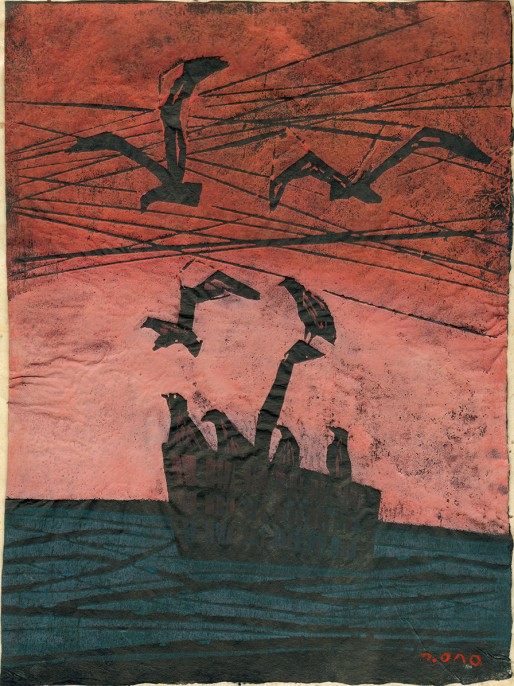
ONO Tadashige was a socially engaged printmaker who, in the Showa era, stood apart from more decorative or flamboyant artistic trends and devoted himself to carving the “weight of everyday life” flowing through the lower strata of the modern city. Working from a resolutely popular viewpoint, he depicted workers, factory districts, and post-earthquake Tokyo—scenes of unembellished reality—through a distinctive style marked by dense, tactile surfaces.
What defines Ono’s art most decisively is his handling of shadow and layering. He repeatedly overprinted different colors, at times carving back into the surface or applying ink thickly onto the block, achieving a depth and physical presence reminiscent of oil painting. The backstreets of Tokyo, smokestacks belching soot, and solitary figures standing at dusk in his works all appear taciturn and restrained, yet within them lies the unyielding will of people buffeted by their times. Where Hiratsuka Un’ichi pursued the aesthetics of black and white, and Onchi Koshiro sought lyricism, Ono consistently focused on the tangible materiality of “reality” as it existed in the overlooked corners of the city.
In his later years, Ono also produced numerous landscapes and travel sketches from abroad, yet even then his touch retained a deep empathy for his subjects and a kind of earthy, grounded strength. The prints of ONO Tadashige are not meant simply to be admired as beautiful scenes; they exist to bear witness to the traces of human lives embedded within them. Heavy and dark, yet somehow warm, his world of black stands as a woodblock monument that most faithfully records Japan’s turbulent passage from the prewar to the postwar era.
What defines Ono’s art most decisively is his handling of shadow and layering. He repeatedly overprinted different colors, at times carving back into the surface or applying ink thickly onto the block, achieving a depth and physical presence reminiscent of oil painting. The backstreets of Tokyo, smokestacks belching soot, and solitary figures standing at dusk in his works all appear taciturn and restrained, yet within them lies the unyielding will of people buffeted by their times. Where Hiratsuka Un’ichi pursued the aesthetics of black and white, and Onchi Koshiro sought lyricism, Ono consistently focused on the tangible materiality of “reality” as it existed in the overlooked corners of the city.
In his later years, Ono also produced numerous landscapes and travel sketches from abroad, yet even then his touch retained a deep empathy for his subjects and a kind of earthy, grounded strength. The prints of ONO Tadashige are not meant simply to be admired as beautiful scenes; they exist to bear witness to the traces of human lives embedded within them. Heavy and dark, yet somehow warm, his world of black stands as a woodblock monument that most faithfully records Japan’s turbulent passage from the prewar to the postwar era.