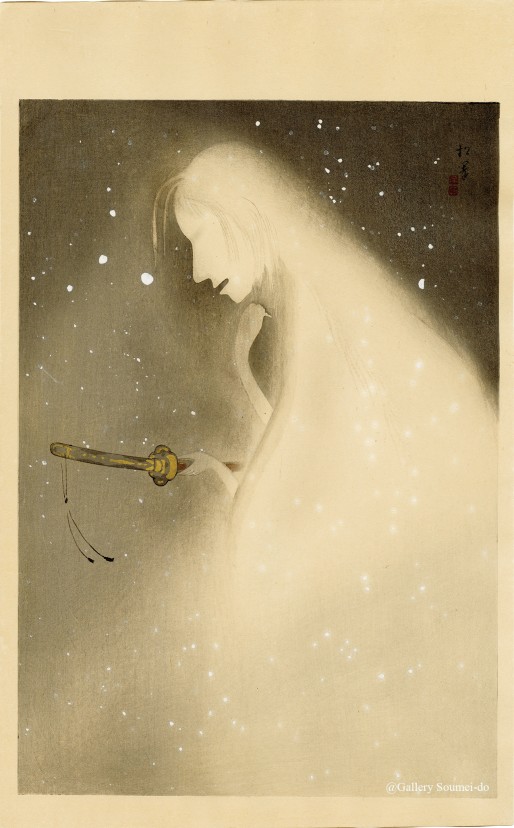
UEMURA Shoen is widely regarded as the greatest master of modern Japanese bijin-ga (images of beautiful women), having consistently pursued what she described as “paintings like fragrant jewels—pure and clear, without a single trace of vulgarity” throughout the Meiji, Taisho, and Showa periods. Born in Kyoto, she forged an extraordinary path at a time when it was exceedingly difficult for women to become professional artists. Studying under such masters as Suzuki Shonen, Kono Bairei, and Takeuchi Seiho, she ultimately became the first Japanese woman to be awarded the Order of Culture.
The women Shoen depicted possess a dignified grace and a profound spirituality that seems to emanate from within. Drawing inspiration from Edo-period customs and classical literature, she did not merely revive the past; instead, through a modern sense of realism, she created an idealized image of womanhood. Her depictions are especially celebrated for their luminous white skin and the meticulous kebori technique, in which individual strands of hair are rendered one by one from the roots. This extraordinary refinement, evident in both painting and prints, draws the viewer into a serene and contemplative world.
Shoen devoted her life to the pursuit of a timeless and universal ideal of beauty. The unwavering compositions and pure, restrained color palettes seen in her masterpieces—such as Jo-no-mai and Hanagatami—appear to embody her own life, shaped by perseverance through countless hardships and an unwavering dedication to the path of art.
The women Shoen depicted possess a dignified grace and a profound spirituality that seems to emanate from within. Drawing inspiration from Edo-period customs and classical literature, she did not merely revive the past; instead, through a modern sense of realism, she created an idealized image of womanhood. Her depictions are especially celebrated for their luminous white skin and the meticulous kebori technique, in which individual strands of hair are rendered one by one from the roots. This extraordinary refinement, evident in both painting and prints, draws the viewer into a serene and contemplative world.
Shoen devoted her life to the pursuit of a timeless and universal ideal of beauty. The unwavering compositions and pure, restrained color palettes seen in her masterpieces—such as Jo-no-mai and Hanagatami—appear to embody her own life, shaped by perseverance through countless hardships and an unwavering dedication to the path of art.