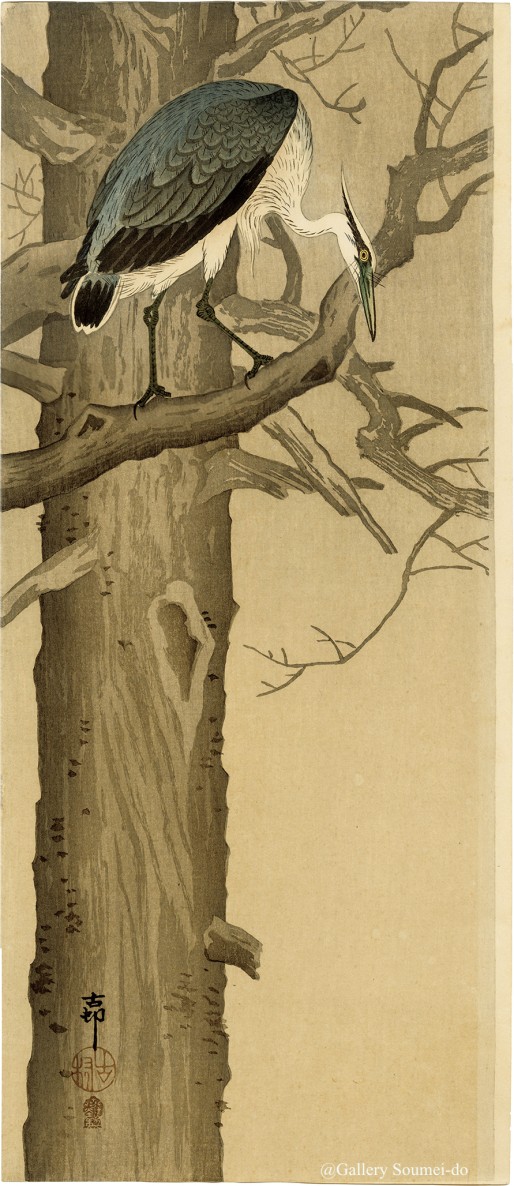
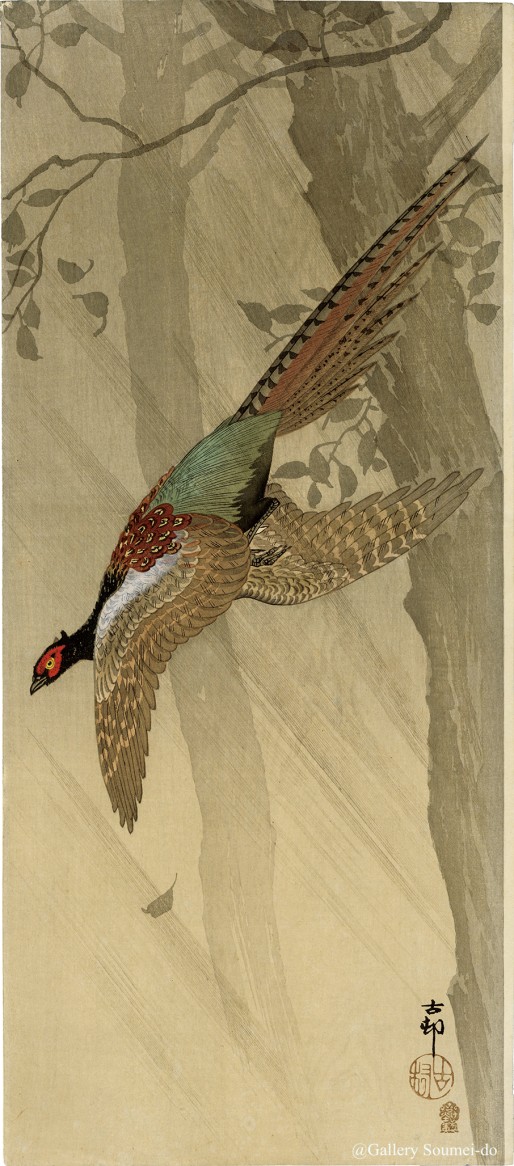
Koson was a master of bird-and-flower prints who was active from the Meiji period through the early Showa era, and who enjoyed especially great popularity overseas. While firmly rooted in the lineage of Edo-period ukiyo-e, he developed a distinctive aesthetic that skillfully incorporated Western realism, allowing him to depict the natural world of Japan with extraordinary precision.
The most defining feature of Koson’s work lies in his ability to reproduce the delicacy of nihonga painting—its subtle brushwork and sense of atmosphere—while working within the traditional medium of woodblock printing. He initially studied Japanese painting under Suzuki Kason, and drawing on his solid powers of observation, he rendered each individual feather of a bird and the soft textures of plants with astonishing detail. Many of his works were exported to Europe and the United States at a time when Western audiences were deeply captivated by Japanese art, and his serene, dignified style came to be highly regarded abroad as a quintessential expression of “Japanese beauty.”
In the Showa period, he participated in the shin-hanga movement, working under the names Shoson and Hōson. Prints from this later phase are characterized by even more refined color harmonies and complex printing techniques that convey subtle shifts of light, giving the works a depth more akin to that of a single painting than a conventional print. Unbound by any specific school or narrative, Koson devoted himself to capturing the beauty of life as it appears before the eye. His pared-down compositions and sophisticated use of negative space possess a modern sensibility that resonates even with contemporary graphic design. Long after his death, his work has been reappraised in Japan as well. Within the lineage of ukiyo-e extending from the Edo period into the modern era, Koson stands as a solitary figure who demonstrated new possibilities for woodblock printing to the world through the timeless subject of birds and flowers.
The most defining feature of Koson’s work lies in his ability to reproduce the delicacy of nihonga painting—its subtle brushwork and sense of atmosphere—while working within the traditional medium of woodblock printing. He initially studied Japanese painting under Suzuki Kason, and drawing on his solid powers of observation, he rendered each individual feather of a bird and the soft textures of plants with astonishing detail. Many of his works were exported to Europe and the United States at a time when Western audiences were deeply captivated by Japanese art, and his serene, dignified style came to be highly regarded abroad as a quintessential expression of “Japanese beauty.”
In the Showa period, he participated in the shin-hanga movement, working under the names Shoson and Hōson. Prints from this later phase are characterized by even more refined color harmonies and complex printing techniques that convey subtle shifts of light, giving the works a depth more akin to that of a single painting than a conventional print. Unbound by any specific school or narrative, Koson devoted himself to capturing the beauty of life as it appears before the eye. His pared-down compositions and sophisticated use of negative space possess a modern sensibility that resonates even with contemporary graphic design. Long after his death, his work has been reappraised in Japan as well. Within the lineage of ukiyo-e extending from the Edo period into the modern era, Koson stands as a solitary figure who demonstrated new possibilities for woodblock printing to the world through the timeless subject of birds and flowers.