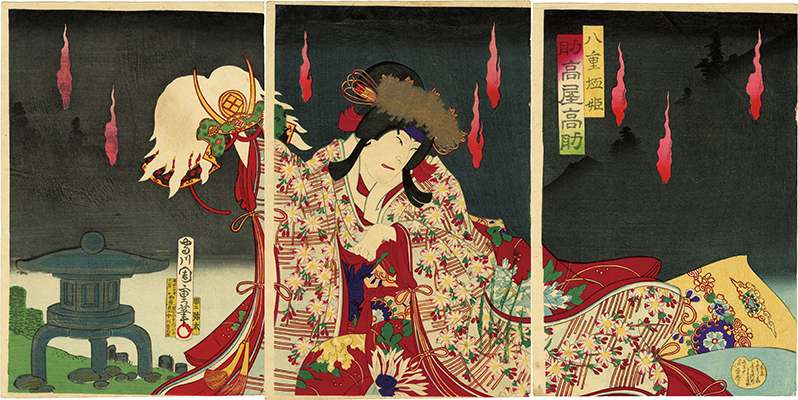
Chikashige was an artist active from the early to mid-Meiji period (from the late 1860s through the 1890s). A pupil of Kunichika, he demonstrated his talent primarily in the genre of actor prints, the field in which his master particularly excelled. Early in his career he used the name Shigenobu, later changing it to Chikashige.
Chikashige ’s greatest achievement lies in his vivid portrayal of kabuki in the new Meiji era, rendered with the brilliant colors and dynamic compositions inherited from his teacher. His actor prints are especially noted for their use of the fashionable aniline dyes of the time, resulting in striking red-toned prints that vividly convey the excitement and energy of the kabuki stage during the period of rapid modernization.
In addition to actor prints, he was also active in producing kaika-e, depicting the streets of early Meiji Tokyo and its new architecture, as well as shinbun nishiki-e, prints illustrating contemporary news events. While clearly rooted in Kunichika’s style, the figures in Chikashige’s works display sharper, more lifelike expressions and movement, embodying the distinctive appeal of a transitional moment when Edo-period ukiyo-e was evolving toward modern illustration.
Chikashige ’s greatest achievement lies in his vivid portrayal of kabuki in the new Meiji era, rendered with the brilliant colors and dynamic compositions inherited from his teacher. His actor prints are especially noted for their use of the fashionable aniline dyes of the time, resulting in striking red-toned prints that vividly convey the excitement and energy of the kabuki stage during the period of rapid modernization.
In addition to actor prints, he was also active in producing kaika-e, depicting the streets of early Meiji Tokyo and its new architecture, as well as shinbun nishiki-e, prints illustrating contemporary news events. While clearly rooted in Kunichika’s style, the figures in Chikashige’s works display sharper, more lifelike expressions and movement, embodying the distinctive appeal of a transitional moment when Edo-period ukiyo-e was evolving toward modern illustration.