TOBARI Kogan was a pioneering figure who, from the late Meiji period through the Taisho era, brought a quiet revolution to modern Japanese art through both sculpture and printmaking.
The defining characteristic of Kogan’s work lies in its robust, corporeal sense of form, shaped consistently by a sculptor’s eye. After studying in the United States and Europe and experiencing a profound impact from the art of Auguste Rodin, he returned to Japan and began producing works that decisively departed from the flat, highly stylized traditions of ukiyo-e. In their place, he introduced forms rich in volume and vitality. His carving marks are not merely lines to delineate shapes; they are the physical act of cutting into the woodblock itself, and from the surface one can almost sense the subject’s breath and body heat.
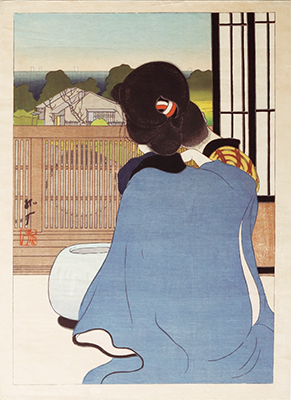
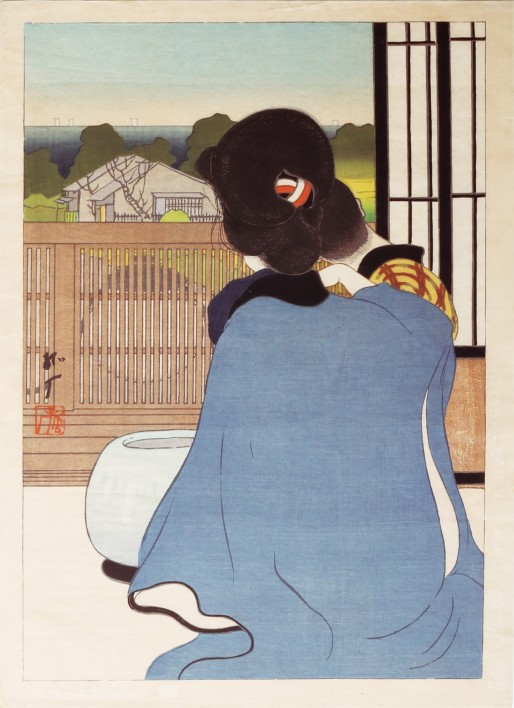
His portrayals of women and genre scenes, in particular, embody the lyricism of Taisho Romanticism while possessing a certain solidity and existential weight. Masterpieces such as The Great Bridge at Senju (Senju no Obashi) and his many bijin-ga capture the bustle and loneliness of the modern city with a deep spiritual intensity and a distinctly modernist sensibility.
Kogan believed that art should not belong to a privileged few, but should exist in resonance with the atmosphere of its time and the breathing presence of the people. Although his life was cut short at the age of forty-four, the “vital energy of life” that Tobari Kogan carved into his blocks became a powerful springboard, enabling modern Japanese printmaking to break free from craft and leap decisively toward the realm of fine art.
The defining characteristic of Kogan’s work lies in its robust, corporeal sense of form, shaped consistently by a sculptor’s eye. After studying in the United States and Europe and experiencing a profound impact from the art of Auguste Rodin, he returned to Japan and began producing works that decisively departed from the flat, highly stylized traditions of ukiyo-e. In their place, he introduced forms rich in volume and vitality. His carving marks are not merely lines to delineate shapes; they are the physical act of cutting into the woodblock itself, and from the surface one can almost sense the subject’s breath and body heat.
His portrayals of women and genre scenes, in particular, embody the lyricism of Taisho Romanticism while possessing a certain solidity and existential weight. Masterpieces such as The Great Bridge at Senju (Senju no Obashi) and his many bijin-ga capture the bustle and loneliness of the modern city with a deep spiritual intensity and a distinctly modernist sensibility.
Kogan believed that art should not belong to a privileged few, but should exist in resonance with the atmosphere of its time and the breathing presence of the people. Although his life was cut short at the age of forty-four, the “vital energy of life” that Tobari Kogan carved into his blocks became a powerful springboard, enabling modern Japanese printmaking to break free from craft and leap decisively toward the realm of fine art.