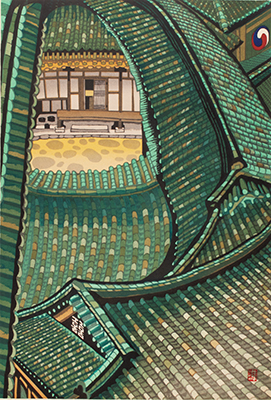
SEKINO Junichiro was a master printmaker who, from the Showa through the Heisei periods, led modern Japanese printmaking with astonishing versatility and a sure command of depiction. Trained under Onchi Koshiro, he inherited the spirit of sōsaku hanga (creative printmaking) while achieving the highest level across an extraordinary range of genres—figures, landscapes, still lifes, and even book design—earning him a reputation as a truly “universal” printmaker.
One of the major culminations of Sekino’s career is his lifelong project, the Fifty-three Stations of the Tokaido series. Reinterpreting Hiroshige’s classic theme through a contemporary sensibility, this body of work captures the “air of the present” of each locale through bold compositions and vivid color. While paying homage to Hiroshige, the time flowing through these landscapes is unmistakably modern, resulting in masterpieces that shine with Sekino’s distinctive graphic sensibility.
Sekino was also highly acclaimed as a master of portraiture. His portraits of fellow artists with whom he shared close ties—such as Munakata Shiko and Onchi Koshiro—go beyond mere likeness, powerfully conveying the vitality of the subject’s spirit and inner tensions through carving marks that are at once forceful and refined. Though shaped by the characteristic deformation of woodblock printing, his figures confront the viewer with an extraordinary sense of presence.
Technically, Sekino worked with remarkable freedom across a wide range of media, including woodblock printing, etching, lithography, and silkscreen. Constantly in search of new modes of expression, he devoted himself to expanding the possibilities of printmaking. At the core of his creativity lay early impressions of the Nebuta Festival he witnessed in Aomori, as well as a deep admiration for ukiyo-e—sources of earthy, dynamic energy that he transformed into a sophisticated and modern visual language uniquely his own.
One of the major culminations of Sekino’s career is his lifelong project, the Fifty-three Stations of the Tokaido series. Reinterpreting Hiroshige’s classic theme through a contemporary sensibility, this body of work captures the “air of the present” of each locale through bold compositions and vivid color. While paying homage to Hiroshige, the time flowing through these landscapes is unmistakably modern, resulting in masterpieces that shine with Sekino’s distinctive graphic sensibility.
Sekino was also highly acclaimed as a master of portraiture. His portraits of fellow artists with whom he shared close ties—such as Munakata Shiko and Onchi Koshiro—go beyond mere likeness, powerfully conveying the vitality of the subject’s spirit and inner tensions through carving marks that are at once forceful and refined. Though shaped by the characteristic deformation of woodblock printing, his figures confront the viewer with an extraordinary sense of presence.
Technically, Sekino worked with remarkable freedom across a wide range of media, including woodblock printing, etching, lithography, and silkscreen. Constantly in search of new modes of expression, he devoted himself to expanding the possibilities of printmaking. At the core of his creativity lay early impressions of the Nebuta Festival he witnessed in Aomori, as well as a deep admiration for ukiyo-e—sources of earthy, dynamic energy that he transformed into a sophisticated and modern visual language uniquely his own.