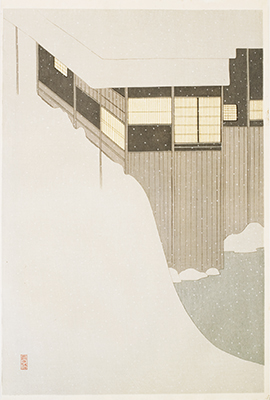
KOMURA Settai was a Nihonga artist and book designer active from the Taisho to the Showa era, highly acclaimed for his sophisticated bijin-ga (portraits of beautiful women) and his decorative, urban aesthetic. Grounded in the foundations of Japanese painting, he showcased his talent across a wide range of fields—including illustration, book design, and stage design—to establish a unique world of beauty.
A defining characteristic of Settai’s work is a refined elegance born from concise, minimalist compositions and a restrained color palette. His female figures, often referred to as "Settai-style beauties," exude a powerful presence through their dignified forms and quiet expressions, intentionally avoiding flamboyant ornamentation. His strategic use of negative space (yohaku) and sharp, beautiful line work evoke a sense of sophisticated tension and stillness in the viewer.
Settai also demonstrated exceptional talent in book design and illustration. His ability to skillfully calculate the relationship between text, imagery, and empty space to create visual expressions in harmony with the content is a testament to his heightened aesthetic sense. His decorativeness is never excessive; rather, it leaves an intellectual and cosmopolitan impression.
The work of Komura Settai represents a quiet fusion of Japanese emotional resonance and modern sensibility. His approach to beauty—understated yet leaving a lasting impression—continues to fascinate many today as a quintessential example of sophisticated Japanese aesthetics.
A defining characteristic of Settai’s work is a refined elegance born from concise, minimalist compositions and a restrained color palette. His female figures, often referred to as "Settai-style beauties," exude a powerful presence through their dignified forms and quiet expressions, intentionally avoiding flamboyant ornamentation. His strategic use of negative space (yohaku) and sharp, beautiful line work evoke a sense of sophisticated tension and stillness in the viewer.
Settai also demonstrated exceptional talent in book design and illustration. His ability to skillfully calculate the relationship between text, imagery, and empty space to create visual expressions in harmony with the content is a testament to his heightened aesthetic sense. His decorativeness is never excessive; rather, it leaves an intellectual and cosmopolitan impression.
The work of Komura Settai represents a quiet fusion of Japanese emotional resonance and modern sensibility. His approach to beauty—understated yet leaving a lasting impression—continues to fascinate many today as a quintessential example of sophisticated Japanese aesthetics.