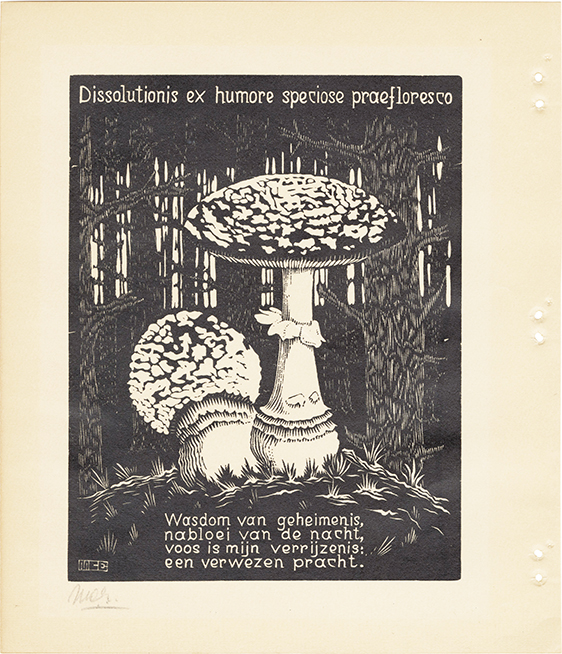
Maurits Escher was a leading Dutch printmaker of the twentieth century who gave visual form to “impossible figures” and “infinite repetition” through rigorous geometric structures and extraordinarily precise draftsmanship. He regarded himself less as an “artist” than as something closer to a mathematician or graphic artist, and he pursued a kind of visual alchemy by mastering every major printmaking technique, including woodcut, lithography, and mezzotint.
At the core of Escher’s art lies the method of tessellation—the regular division of the plane. Deeply influenced by the tile decorations of the Alhambra Palace, he depicted lizards, birds, fish, and other concrete motifs transforming into one another while filling the picture plane seamlessly, without gaps. This was not mere ornamentation, but a rigorous exploration of infinity grounded in mathematical order, pushing to its limits the essential nature of printmaking as a medium based on repetition.
Escher also created powerful “visual paradoxes” by turning the rules of perspective against themselves. In works such as Ascending and Descending, with its staircase that endlessly rises yet returns to its starting point, or Belvedere, where interior and exterior spaces remain logically inconsistent yet visually connected, the subtle tonal gradations of lithography lend overwhelming plausibility to a false three-dimensional space. This form of “logical absurdity” has long fascinated mathematicians and scientists, continually stimulating their ways of thinking.
Although founded on meticulous calculation, Escher’s prints possess a distinctly dreamlike, meditative stillness. Through the solitary, manual labor of carving woodblocks and polishing lithographic stones, he crystallized the “structure of the world” that existed within his own mind into forms visible to our eyes.
At the core of Escher’s art lies the method of tessellation—the regular division of the plane. Deeply influenced by the tile decorations of the Alhambra Palace, he depicted lizards, birds, fish, and other concrete motifs transforming into one another while filling the picture plane seamlessly, without gaps. This was not mere ornamentation, but a rigorous exploration of infinity grounded in mathematical order, pushing to its limits the essential nature of printmaking as a medium based on repetition.
Escher also created powerful “visual paradoxes” by turning the rules of perspective against themselves. In works such as Ascending and Descending, with its staircase that endlessly rises yet returns to its starting point, or Belvedere, where interior and exterior spaces remain logically inconsistent yet visually connected, the subtle tonal gradations of lithography lend overwhelming plausibility to a false three-dimensional space. This form of “logical absurdity” has long fascinated mathematicians and scientists, continually stimulating their ways of thinking.
Although founded on meticulous calculation, Escher’s prints possess a distinctly dreamlike, meditative stillness. Through the solitary, manual labor of carving woodblocks and polishing lithographic stones, he crystallized the “structure of the world” that existed within his own mind into forms visible to our eyes.