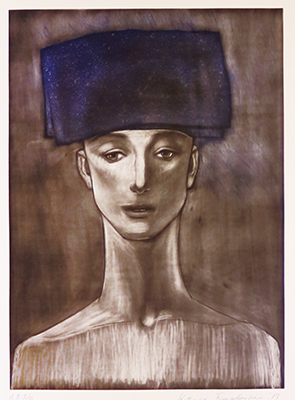
FUNAKOSHI Katsura was one of the most important sculptors of contemporary Japan, an artist who redefined the concept of sculpture through wooden figures that embody profound spirituality within an atmosphere of quiet stillness. The son of FUNAKOSHI Yasutake, a leading figure in postwar Japanese figurative sculpture, he inherited traditional wood-carving techniques while presenting an entirely new, contemporary vision of human presence.
In discussing Funakoshi’s artistic world, printmaking must not be regarded as a mere secondary practice. Rather, it stands as an essential mode of expression, in dialogue with his sculpture. Throughout his career, he produced a substantial body of prints in which a different kind of introspection emerges—one shaped not by carving into wood, but by the subtle wavering of line and the depth of his sustained contemplation.
For Funakoshi, printmaking also functioned as a laboratory for exploring inexpressible emotions that sculpture alone could not fully contain. Expressions that were physically difficult to realize in sculpture—such as hair seemingly stirred by the wind, or a presence hovering uncertainly in space—unfold freely within the pictorial field of his prints. The figures that appear in these works share the same quiet gaze reminiscent of “marble eyes” seen in his sculptures, yet on paper they convey a more intimate, inward quality, as if offering a private monologue directly to the viewer.
It is particularly revealing that Funakoshi rarely used prints to sketch or finalize sculptural compositions. For him, printmaking constituted an autonomous realm, complete in its own right. Images born through the indirect process of printmaking often reveal expressions shaped by chance—moments that exceed the artist’s conscious intention. This inherent quality of printmaking, in which forces beyond the self intervene, became one of the most effective means through which Funakoshi pursued his lifelong inquiry into the enigmatic nature of human existence.
In discussing Funakoshi’s artistic world, printmaking must not be regarded as a mere secondary practice. Rather, it stands as an essential mode of expression, in dialogue with his sculpture. Throughout his career, he produced a substantial body of prints in which a different kind of introspection emerges—one shaped not by carving into wood, but by the subtle wavering of line and the depth of his sustained contemplation.
For Funakoshi, printmaking also functioned as a laboratory for exploring inexpressible emotions that sculpture alone could not fully contain. Expressions that were physically difficult to realize in sculpture—such as hair seemingly stirred by the wind, or a presence hovering uncertainly in space—unfold freely within the pictorial field of his prints. The figures that appear in these works share the same quiet gaze reminiscent of “marble eyes” seen in his sculptures, yet on paper they convey a more intimate, inward quality, as if offering a private monologue directly to the viewer.
It is particularly revealing that Funakoshi rarely used prints to sketch or finalize sculptural compositions. For him, printmaking constituted an autonomous realm, complete in its own right. Images born through the indirect process of printmaking often reveal expressions shaped by chance—moments that exceed the artist’s conscious intention. This inherent quality of printmaking, in which forces beyond the self intervene, became one of the most effective means through which Funakoshi pursued his lifelong inquiry into the enigmatic nature of human existence.