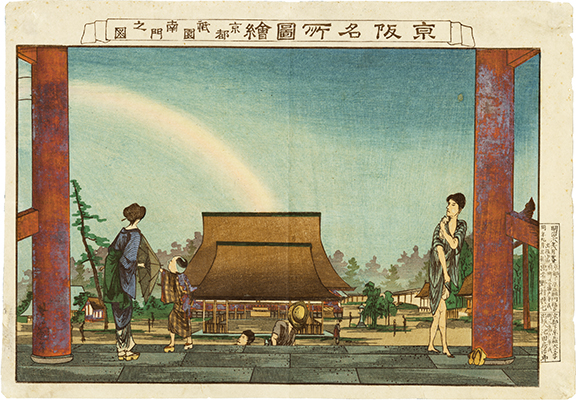
Yoshikuni II was a leading master who brought the Kamigata tradition of ukiyo-e to its final flowering from the late Edo period into the Meiji era. The culmination of his artistic career can be seen in the series Illustrated Views of Famous Places in Kyoto and Osaka (Keihan meisho zue). In this body of work, while inheriting the established lineage of landscape prints that had developed from Edo to Osaka, he boldly incorporated the techniques of kosen-ga (light-ray prints) pioneered by Kiyochika, which were then creating a sensation in Tokyo, and in doing so opened up a new horizon for landscape imagery.
The views of Kyoto and Osaka depicted by Yoshikuni mark a decisive departure from the descriptive, bustling manner that had characterized earlier Kamigata prints. Through a delicate treatment of light learned from Kiyochika, his landscapes came to be imbued with a profound emotional resonance. Making frequent use of bokashi gradation to render shifting skies and shimmering reflections on water, he created lyrical compositions that convey not merely a record of place, but the very atmosphere and humidity of a fleeting moment. Just as Kiyochika pursued gaslit streets and twilight in Tokyo, Yoshikuni infused familiar scenes—such as Hachikenya in Osaka and the Kamo River in Kyoto—with the “light” of the new Meiji era.
Despite this clear influence from Kiyochika, Yoshikuni never lost his identity as a Kamigata artist. Whereas Kiyochika’s light-ray prints often emphasize silence and melancholy, Yoshikuni’s works remain animated by the Kamigata aesthetic: a brilliant sense of color and a meticulous attention to detail that breathe vitality into every scene.
The views of Kyoto and Osaka depicted by Yoshikuni mark a decisive departure from the descriptive, bustling manner that had characterized earlier Kamigata prints. Through a delicate treatment of light learned from Kiyochika, his landscapes came to be imbued with a profound emotional resonance. Making frequent use of bokashi gradation to render shifting skies and shimmering reflections on water, he created lyrical compositions that convey not merely a record of place, but the very atmosphere and humidity of a fleeting moment. Just as Kiyochika pursued gaslit streets and twilight in Tokyo, Yoshikuni infused familiar scenes—such as Hachikenya in Osaka and the Kamo River in Kyoto—with the “light” of the new Meiji era.
Despite this clear influence from Kiyochika, Yoshikuni never lost his identity as a Kamigata artist. Whereas Kiyochika’s light-ray prints often emphasize silence and melancholy, Yoshikuni’s works remain animated by the Kamigata aesthetic: a brilliant sense of color and a meticulous attention to detail that breathe vitality into every scene.