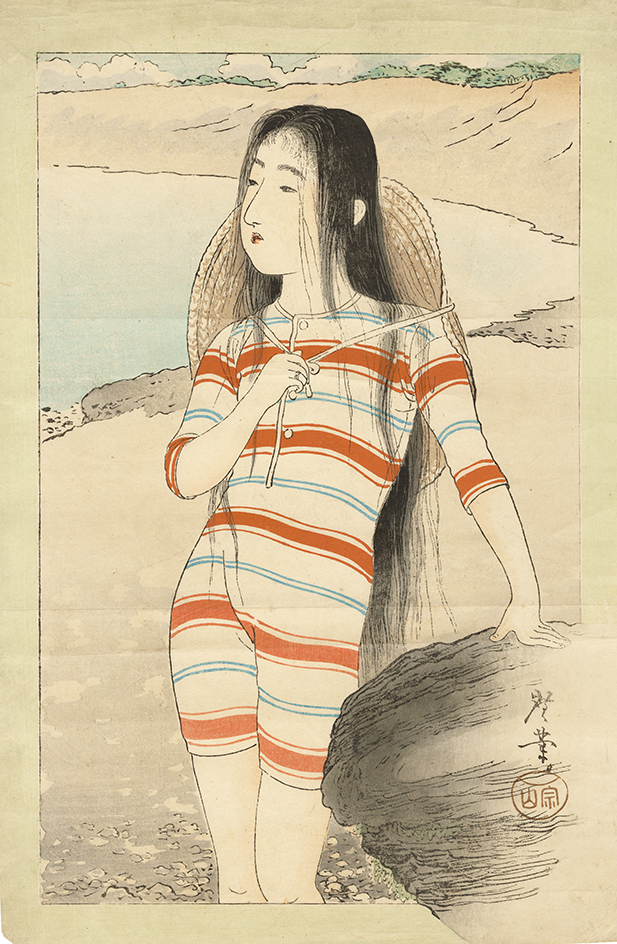
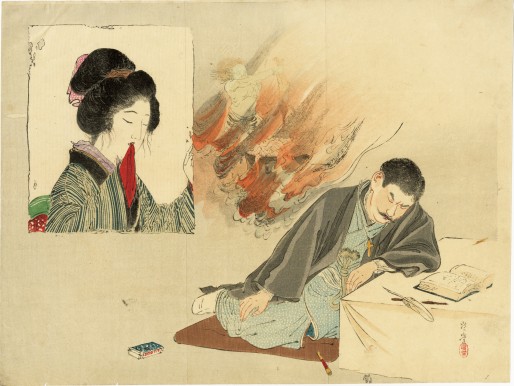
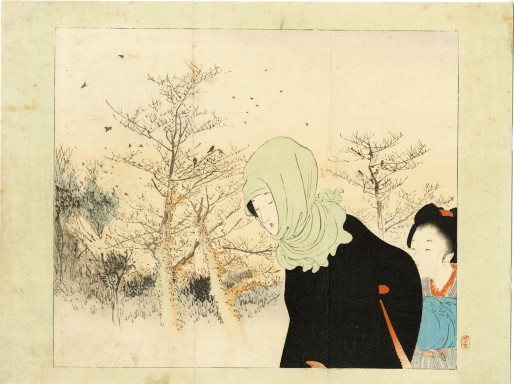
Terasaki Kogyo was a master who stood at the pinnacle of the Japanese painting world from the Meiji to the Taisho period, and is regarded—alongside figures such as Yokoyama Taikan and Shimomura Kanzan—as one of the “fathers of modern Japanese painting.” His greatest appeal lies in his protean style, free from the constraints of any single school, and in the brilliance of his overwhelming technique, which allowed him to render any subject with elegance and authority.
The women depicted by Kogyo retain the refined formal beauty of traditional ukiyo-e while at the same time exuding the intellect and dignity of the new Meiji era. He also produced numerous frontispiece illustrations for magazines such as Bungei Kurabu, contributing significantly to the elevation of woodblock printmaking to a fully realized artistic medium.
Kogyo’s true power is also found in the speed of his brushwork and the sophistication of his compositions. As a professor at the Tokyo Fine Arts School (now Tokyo University of the Arts), he trained the next generation of artists, including Hirafuku Hyakusui. Rather than merely preserving old traditions, he continually sought new forms of Japanese painting that responded to the demands of his time. His works bring together the severity of nature and the fleeting elegance found in everyday moments, greatly expanding the expressive possibilities of Japanese painting.
The women depicted by Kogyo retain the refined formal beauty of traditional ukiyo-e while at the same time exuding the intellect and dignity of the new Meiji era. He also produced numerous frontispiece illustrations for magazines such as Bungei Kurabu, contributing significantly to the elevation of woodblock printmaking to a fully realized artistic medium.
Kogyo’s true power is also found in the speed of his brushwork and the sophistication of his compositions. As a professor at the Tokyo Fine Arts School (now Tokyo University of the Arts), he trained the next generation of artists, including Hirafuku Hyakusui. Rather than merely preserving old traditions, he continually sought new forms of Japanese painting that responded to the demands of his time. His works bring together the severity of nature and the fleeting elegance found in everyday moments, greatly expanding the expressive possibilities of Japanese painting.