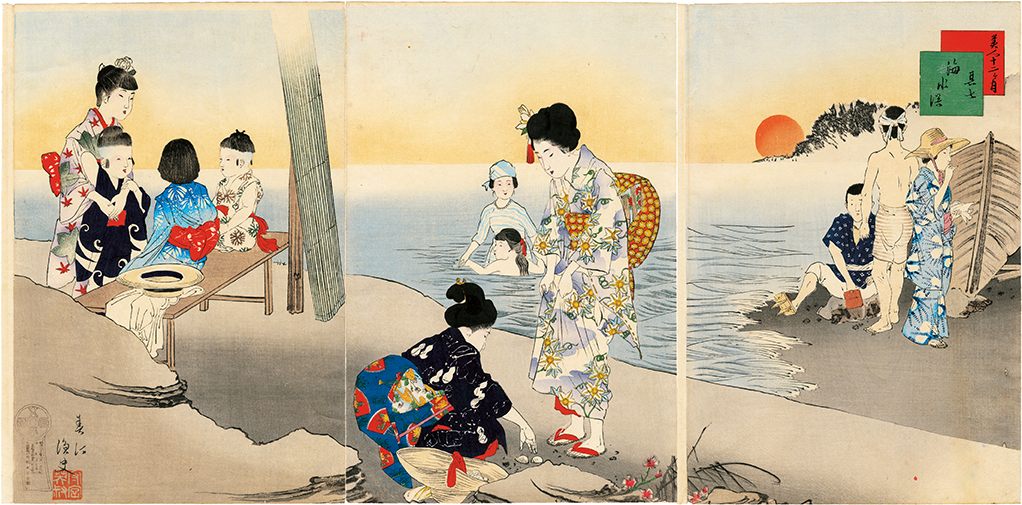
Shuntei was an ukiyo-e artist active from the Meiji to the Taisho period, and a pioneering figure who opened up a new Meiji sensibility, particularly in the field of bijinga (images of beautiful women). While firmly grounded in traditional ukiyo-e techniques, he incorporated the realism and delicate color palettes of Western painting, leaving behind many works that embodied Meiji modernity and clearly distinguished themselves from Edo-period ukiyo-e.
His true strength lies above all in his keen eye for capturing women’s everyday lives with freshness and vitality. Unlike the codified beauty of Edo-period imagery, his women convey an emotional presence through which one can almost feel the warmth of their skin, the texture of their hair, and even the atmosphere of the moment. Rather than merely depicting beautiful women, Shuntei sought to portray the very era they inhabited.
In particular, his line work combines sharpness and softness in equal measure. While he renders kimono patterns and accessories with remarkable precision, he leaves a gentle sensitivity in the expressions of his figures, allowing their inner emotions to subtly emerge.
His true strength lies above all in his keen eye for capturing women’s everyday lives with freshness and vitality. Unlike the codified beauty of Edo-period imagery, his women convey an emotional presence through which one can almost feel the warmth of their skin, the texture of their hair, and even the atmosphere of the moment. Rather than merely depicting beautiful women, Shuntei sought to portray the very era they inhabited.
In particular, his line work combines sharpness and softness in equal measure. While he renders kimono patterns and accessories with remarkable precision, he leaves a gentle sensitivity in the expressions of his figures, allowing their inner emotions to subtly emerge.