WATANABE Seitei was a solitary genius who flourished from the Meiji to the Taisho period, astonishing the world with his overwhelming realism and refined sense of color. Like Shibata Zeshin, he grounded his work in techniques inherited from the Edo period, yet elevated them into a modern artistic language, embodying the ultimate expression of what may be called “craft-based painting.”
Seitei’s greatest achievement lies in his fusion of light, shadow, and spatial awareness derived from Western painting with Japanese pictorial traditions, culminating in his own distinctive approach to mokkotsu (boneless painting). Dispensing with outlines, he rendered form and texture through the sheer momentum of the brush and subtle gradations of color. This method allowed him to capture the softness of bird feathers and the vivid freshness of rain-soaked plants with an immediacy that feels almost alive. According to legend, when Seitei traveled to Europe in conjunction with the 1878 Paris Exposition and demonstrated his impromptu painting before Impressionists such as Edgar Degas, they were left speechless by his almost miraculous brushwork—testimony to the fact that his technique far surpassed the global standards of his time.
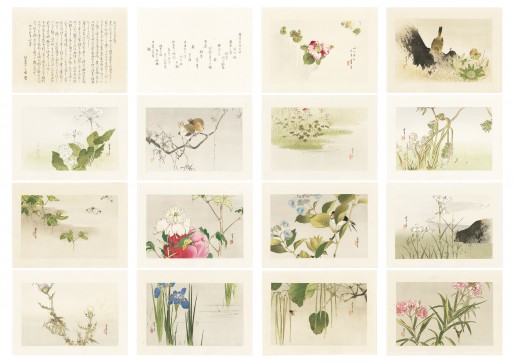
Seitei also left an indispensable legacy in the field of ukiyo-e. In his youth he studied under Kikuchi Yōsai, laying a firm foundation in traditional historical and genre painting, and later produced numerous woodblock prints and book illustrations at the request of publishers. Among these, the Seitei KachoGafu, a series that translates his bird-and-flower paintings into woodblock form, is particularly celebrated. Though printed, the works possess the delicate gradations and atmospheric depth of hand-painted originals. They represent a pinnacle of Meiji-period woodblock printing, into which carvers and printers poured the full extent of their skills in order to faithfully reproduce Seitei’s brushwork.
Seitei’s greatest achievement lies in his fusion of light, shadow, and spatial awareness derived from Western painting with Japanese pictorial traditions, culminating in his own distinctive approach to mokkotsu (boneless painting). Dispensing with outlines, he rendered form and texture through the sheer momentum of the brush and subtle gradations of color. This method allowed him to capture the softness of bird feathers and the vivid freshness of rain-soaked plants with an immediacy that feels almost alive. According to legend, when Seitei traveled to Europe in conjunction with the 1878 Paris Exposition and demonstrated his impromptu painting before Impressionists such as Edgar Degas, they were left speechless by his almost miraculous brushwork—testimony to the fact that his technique far surpassed the global standards of his time.
Seitei also left an indispensable legacy in the field of ukiyo-e. In his youth he studied under Kikuchi Yōsai, laying a firm foundation in traditional historical and genre painting, and later produced numerous woodblock prints and book illustrations at the request of publishers. Among these, the Seitei KachoGafu, a series that translates his bird-and-flower paintings into woodblock form, is particularly celebrated. Though printed, the works possess the delicate gradations and atmospheric depth of hand-painted originals. They represent a pinnacle of Meiji-period woodblock printing, into which carvers and printers poured the full extent of their skills in order to faithfully reproduce Seitei’s brushwork.