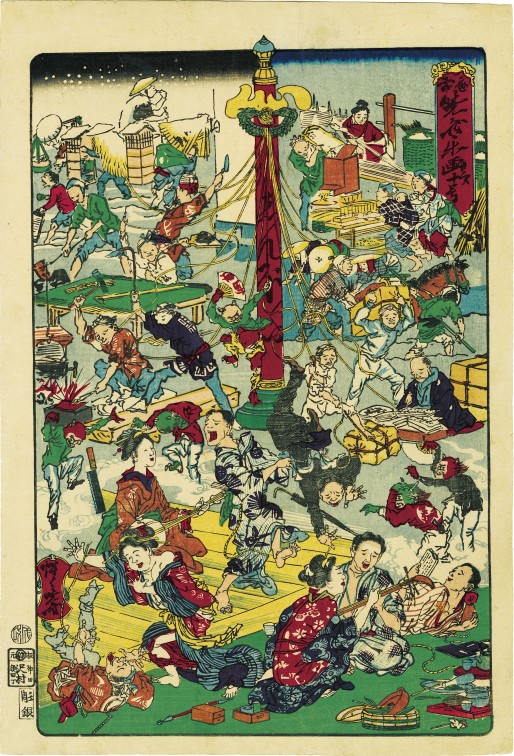
Kyosai was a genius artist active from the late Edo period through the mid-Meiji era, celebrated in the history of Japanese art as the unparalleled “painting demon”. While mastering the orthodox techniques of the Kano school to perfection, he absorbed ukiyo-e, satirical giga, and even the realism of Western painting, dismantling and reconstructing existing artistic frameworks in their entirety.
The true power of Kyosai lies in his overwhelming command of the brush and his obsessive drive to turn every conceivable subject into an image. He depicted life and death, the sacred and the profane, tradition and innovation as parts of a single, continuous world. The animals and supernatural creatures he portrayed possess a visceral dynamism, as if he had an intimate knowledge of skeletal structure and muscular movement, while his Buddhist and historical paintings display the dignity and meticulousness of a true heir to the Kano school. This all-encompassing ability—his capacity to “paint anything”—made him a singular figure who cannot be confined within the categories of ukiyo-e artist or Japanese-style painter.
Kyosai viewed the vast social upheaval of the Meiji Restoration with a sharply satirical eye. Through humorous and biting images in which frogs, skeletons, and gods or Buddhas are anthropomorphized, he mercilessly exposed the absurdities and contradictions of the new age, at times even being imprisoned for criticizing the government of the day. Yet at the core of his work was not a destructive impulse, but an insatiable curiosity. He freely absorbed Western techniques and sought to redefine Japanese art from a global perspective. Kyosai’s works are a site where the craftsman’s spirit of Edo collides with the modern, individualistic drive for expression, brimming with the almost manic passion of a man determined to render all things in the universe through painting.
The true power of Kyosai lies in his overwhelming command of the brush and his obsessive drive to turn every conceivable subject into an image. He depicted life and death, the sacred and the profane, tradition and innovation as parts of a single, continuous world. The animals and supernatural creatures he portrayed possess a visceral dynamism, as if he had an intimate knowledge of skeletal structure and muscular movement, while his Buddhist and historical paintings display the dignity and meticulousness of a true heir to the Kano school. This all-encompassing ability—his capacity to “paint anything”—made him a singular figure who cannot be confined within the categories of ukiyo-e artist or Japanese-style painter.
Kyosai viewed the vast social upheaval of the Meiji Restoration with a sharply satirical eye. Through humorous and biting images in which frogs, skeletons, and gods or Buddhas are anthropomorphized, he mercilessly exposed the absurdities and contradictions of the new age, at times even being imprisoned for criticizing the government of the day. Yet at the core of his work was not a destructive impulse, but an insatiable curiosity. He freely absorbed Western techniques and sought to redefine Japanese art from a global perspective. Kyosai’s works are a site where the craftsman’s spirit of Edo collides with the modern, individualistic drive for expression, brimming with the almost manic passion of a man determined to render all things in the universe through painting.