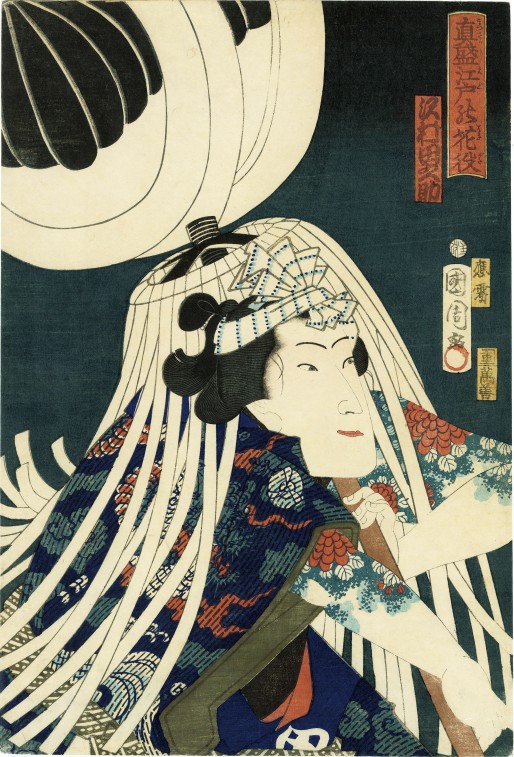
Kunichika was active from the late Edo period through the mid-Meiji era (1835–1900) and is regarded as the “last great actor-print artist,” who upheld the flamboyant traditions of Edo ukiyo-e to the very end. While inheriting the refined stylistic beauty of Toyokuni III, he infused his works with the dynamic energy of the new Meiji era.
Kunichika’s true forte lies above all in his okubi-e (large-head actor portraits). He boldly filled the picture plane with the faces of kabuki actors, capturing the climactic moment of a dramatic mie pose with an intensity comparable to that of a modern close-up photograph. Often called the “Sharaku of the Meiji era,” he possessed an extraordinary talent for expressive exaggeration that sharply emphasized each actor’s individuality, earning him fervent support among theater aficionados.
Kunichika’s life itself was famously unconventional, embodying the free-spirited temperament of an Edokko. He is said to have moved house more than a hundred times and led a highly dissipated private life, yet when brush met paper his powers of concentration were remarkable, enabling him to produce an enormous body of work over his lifetime. Through his single-minded pursuit of “recreating the excitement of the theater on paper,” Kunichika pushed the artistic potential of ukiyo-e to its ultimate limits. With his death, the golden age of traditional actor prints that had flourished since the Edo period is widely considered to have come to a close.
Kunichika’s true forte lies above all in his okubi-e (large-head actor portraits). He boldly filled the picture plane with the faces of kabuki actors, capturing the climactic moment of a dramatic mie pose with an intensity comparable to that of a modern close-up photograph. Often called the “Sharaku of the Meiji era,” he possessed an extraordinary talent for expressive exaggeration that sharply emphasized each actor’s individuality, earning him fervent support among theater aficionados.
Kunichika’s life itself was famously unconventional, embodying the free-spirited temperament of an Edokko. He is said to have moved house more than a hundred times and led a highly dissipated private life, yet when brush met paper his powers of concentration were remarkable, enabling him to produce an enormous body of work over his lifetime. Through his single-minded pursuit of “recreating the excitement of the theater on paper,” Kunichika pushed the artistic potential of ukiyo-e to its ultimate limits. With his death, the golden age of traditional actor prints that had flourished since the Edo period is widely considered to have come to a close.