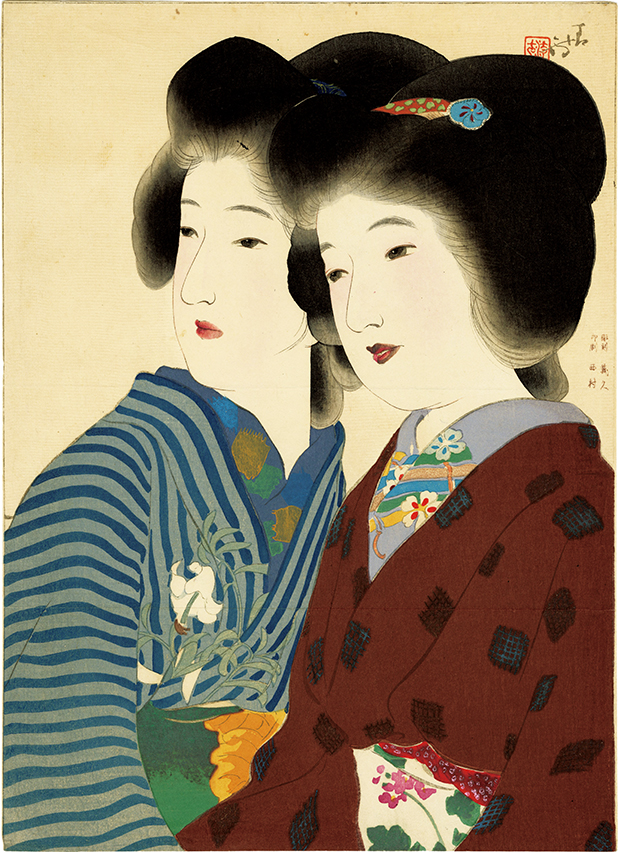
Kiyokata was a master artist who represented modern Japanese painting, active from the late Meiji period through the mid-Showa era (from the 1890s until 1972).
His greatest achievement was fully elevating the ukiyo-e tradition—carried from the Edo period into the Meiji era—into nihonga imbued with a modern aesthetic sensibility. In particular, through his bijinga depicting the quiet, unassuming beauty of women in everyday life and the tender portrayal of ordinary townspeople, he attained a position at the very pinnacle of the genre, often mentioned alongside UEMURA Shoen.
Kiyokata’s artistic origins lie in his work as a kuchi-e illustrator, and as a result, his paintings are suffused with a strong sense of narrative and literary resonance. He held a deep affection for the downtown neighborhoods of Edo- and Meiji-period Tokyo, whose customs and atmosphere were rapidly disappearing, and he rendered these memories with a delicate yet pure brush.
For Kiyokata, kuchi-e were inexpensive works intended for a mass audience, yet they were also a battleground on which he believed one must invest a spirit equal to that of a singular, one-of-a-kind painting. The ability to crystallize an entire story into a single image—refined during his years as a kuchi-e artist—became the unshakable foundation that ultimately elevated him to the status of a master of Japanese painting.
His greatest achievement was fully elevating the ukiyo-e tradition—carried from the Edo period into the Meiji era—into nihonga imbued with a modern aesthetic sensibility. In particular, through his bijinga depicting the quiet, unassuming beauty of women in everyday life and the tender portrayal of ordinary townspeople, he attained a position at the very pinnacle of the genre, often mentioned alongside UEMURA Shoen.
Kiyokata’s artistic origins lie in his work as a kuchi-e illustrator, and as a result, his paintings are suffused with a strong sense of narrative and literary resonance. He held a deep affection for the downtown neighborhoods of Edo- and Meiji-period Tokyo, whose customs and atmosphere were rapidly disappearing, and he rendered these memories with a delicate yet pure brush.
For Kiyokata, kuchi-e were inexpensive works intended for a mass audience, yet they were also a battleground on which he believed one must invest a spirit equal to that of a singular, one-of-a-kind painting. The ability to crystallize an entire story into a single image—refined during his years as a kuchi-e artist—became the unshakable foundation that ultimately elevated him to the status of a master of Japanese painting.