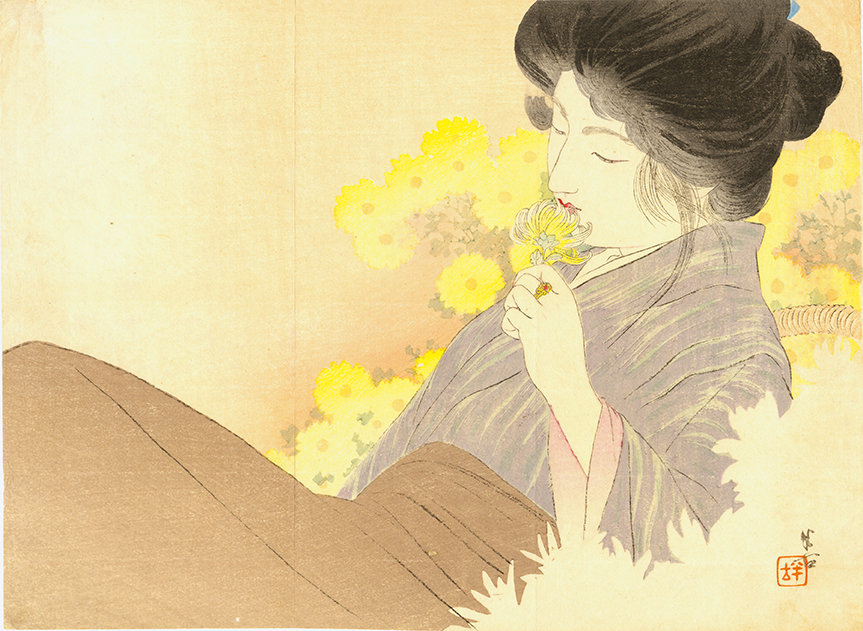
KAJITA Hanko was a painter active from the Meiji to the Taisho period who broke away from the traditional funpon-shugi (copybook-based orthodoxy) of Japanese painting, forging a fresh synthesis of realism and lyrical expression.
Hanko’s most significant achievement lies in his work for magazines such as Bungei Kurabu, where he overturned conventional ukiyo-e–derived modes of expression and established a new style of frontispiece illustration (kuchi-e). These works captured natural, everyday gestures and subtle emotional states, introducing a modern sensitivity that had not existed before.
The women depicted by Hanko possess an intellectual air tinged with quiet melancholy. At the same time, he was deeply engaged in the study of classical painting and historical customs. Drawing on this profound knowledge, he skillfully reinterpreted traditional subjects through a contemporary lens, imbuing figures—especially women—with a distinctly modern sense of grace and dignity.
From Hanko’s circle emerged a remarkable generation of artists, including KOBAYASHI Koikei, MAEDA Seison, and OKUMURA Dogyu, all of whom would later go on to redefine the course of modern Japanese painting.
Through the medium of kuchi-e, Hanko elevated the Japanese sensibility for delicate emotion to the level of modern art. Although produced as woodblock prints, his illustrations convey a painterly, hand-drawn quality, drawing readers deeply into the emotional core of the stories they accompanied.
Hanko’s most significant achievement lies in his work for magazines such as Bungei Kurabu, where he overturned conventional ukiyo-e–derived modes of expression and established a new style of frontispiece illustration (kuchi-e). These works captured natural, everyday gestures and subtle emotional states, introducing a modern sensitivity that had not existed before.
The women depicted by Hanko possess an intellectual air tinged with quiet melancholy. At the same time, he was deeply engaged in the study of classical painting and historical customs. Drawing on this profound knowledge, he skillfully reinterpreted traditional subjects through a contemporary lens, imbuing figures—especially women—with a distinctly modern sense of grace and dignity.
From Hanko’s circle emerged a remarkable generation of artists, including KOBAYASHI Koikei, MAEDA Seison, and OKUMURA Dogyu, all of whom would later go on to redefine the course of modern Japanese painting.
Through the medium of kuchi-e, Hanko elevated the Japanese sensibility for delicate emotion to the level of modern art. Although produced as woodblock prints, his illustrations convey a painterly, hand-drawn quality, drawing readers deeply into the emotional core of the stories they accompanied.