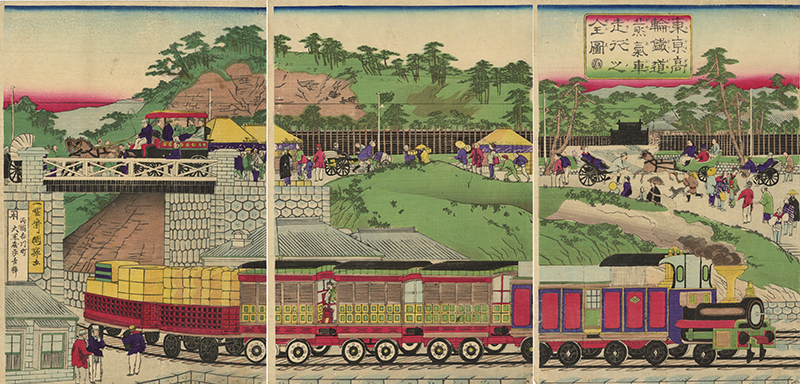
KuniteruII captured the turbulent transition from the Edo period to the Meiji era with piercingly intense colors. While he was a legitimate master of the Utagawa school, inheriting the lineage of Kunisada and skillfully handling traditional subjects such as sumo prints, he also took delight in the sweeping current of modernization. Using vivid synthetic pigments known as aka-e (“red pictures”), he depicted unfamiliar phenomena such as railways, Western-style buildings, and hot-air balloons.
His compositions are highly energetic, and within the panoramic triptych format there emerges a curious sense of reality, created by his somewhat exaggerated adoption of Western perspective. These works are not mere records of scenery; rather, they give visual expression to the exhilaration of the Japanese people of the time, in which confusion and curiosity about a new age were inextricably intertwined.
His compositions are highly energetic, and within the panoramic triptych format there emerges a curious sense of reality, created by his somewhat exaggerated adoption of Western perspective. These works are not mere records of scenery; rather, they give visual expression to the exhilaration of the Japanese people of the time, in which confusion and curiosity about a new age were inextricably intertwined.