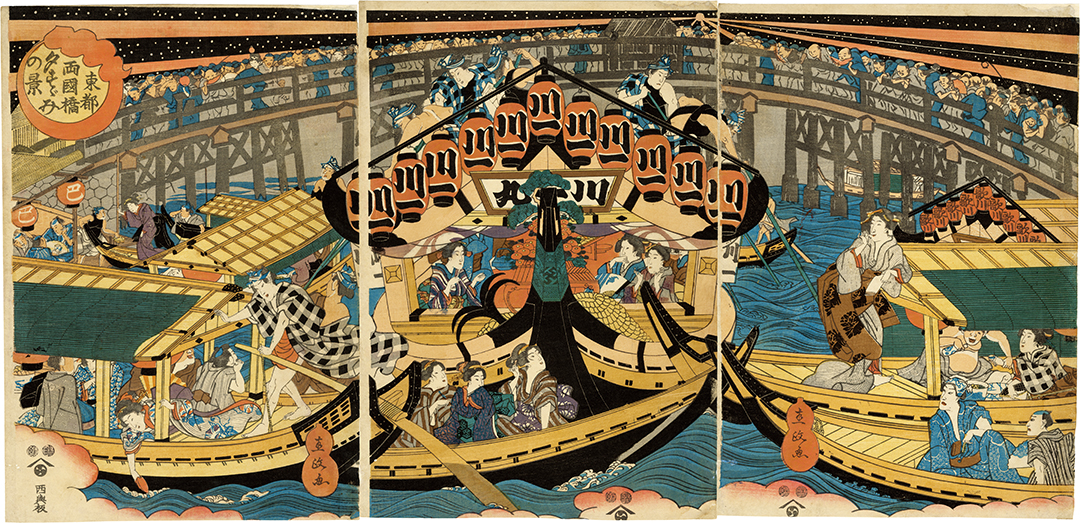
Naomasa was an ukiyo-e artist trained under Kunikata, and the chief appeal of his work lies in the dramatic narrative construction he inherited from his master. Just as Kunikata fused the Katsushika school’s realistic treatment of anatomy and Western-derived spatial perception with the stylistic conventions of the Utagawa school, Naomasa’s works likewise display a solid draftsmanship that gives a sense of inevitability to the movements of his figures.
In warrior prints and historical scenes, he did more than simply depict heroic poses: he created compositions rich in narrative depth, conveying the tension in the air and the psychological conflicts of the figures involved. His works invite close reading, as if unfolding a story before the viewer’s eyes.
Naomasa was also exceptionally meticulous in his rendering of details. Every fold of a garment, the textures of furnishings placed in the background, and even elements of the natural setting are carefully described, reflecting his master’s belief that pictures should tell a story. Distinct from the more flamboyant, visually assertive style associated with Kunisada, Naomasa’s true strength lies in a more intellectual, observation-based realism that permeates his compositions.
In warrior prints and historical scenes, he did more than simply depict heroic poses: he created compositions rich in narrative depth, conveying the tension in the air and the psychological conflicts of the figures involved. His works invite close reading, as if unfolding a story before the viewer’s eyes.
Naomasa was also exceptionally meticulous in his rendering of details. Every fold of a garment, the textures of furnishings placed in the background, and even elements of the natural setting are carefully described, reflecting his master’s belief that pictures should tell a story. Distinct from the more flamboyant, visually assertive style associated with Kunisada, Naomasa’s true strength lies in a more intellectual, observation-based realism that permeates his compositions.