Kunitsuna was a highly accomplished artist who studied under Toyokuni and enjoyed a long career from the Bunsei era of the late Edo period through the early years of the Meiji era. He skillfully handled all the subjects demanded of ukiyo-e at the time—actor prints, bijin-ga, warrior prints, and even book illustrations—consistently maintaining a high level of quality. While his style was grounded in the refined formal beauty inherited from his master, it grew increasingly sharp and dynamic as the end of the Edo period approached.
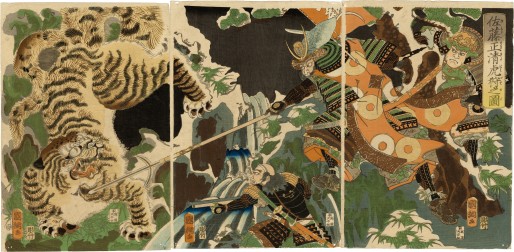
In his warrior prints, Kunitsuna excelled at bold compositions that filled the picture plane with clashing armies and legendary supernatural beings, standing alongside artists such as Kuniyoshi in sustaining the vibrant visual culture of the late Edo period. During the turbulent transition into the Meiji era, he also produced works that conveyed the movements of the new government and changing social customs. In this way, he upheld the traditions of ukiyo-e while also maintaining a calm, observant eye for a society in transformation.
In terms of color, he ranged from restrained, traditional palettes to the vivid hues characteristic of the late Edo period, lending his compositions a striking contrast and powerful visual impact.
In his warrior prints, Kunitsuna excelled at bold compositions that filled the picture plane with clashing armies and legendary supernatural beings, standing alongside artists such as Kuniyoshi in sustaining the vibrant visual culture of the late Edo period. During the turbulent transition into the Meiji era, he also produced works that conveyed the movements of the new government and changing social customs. In this way, he upheld the traditions of ukiyo-e while also maintaining a calm, observant eye for a society in transformation.
In terms of color, he ranged from restrained, traditional palettes to the vivid hues characteristic of the late Edo period, lending his compositions a striking contrast and powerful visual impact.