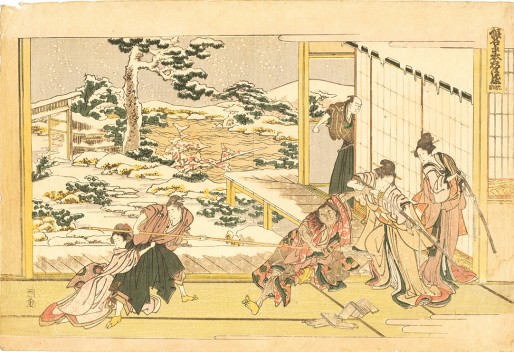
Hokusai was a preeminent ukiyo-e artist of the late Edo period, renowned for his mastery over a vast array of subjects, including landscapes, flowers and birds, and portraits of beautiful women. Over a prolific career spanning seventy years-from 1779 to 1849-he sought to depict the "all things in the universe" (shinra bansho). His body of work, exceeding 34,000 pieces, encompasses everything from human gestures and historical figures (including courtesans, sumo wrestlers, and actors) to landscapes such as Mount Fuji, waterfalls, and bridges. His brush also captured insects, birds, flora, architecture, Buddhist ritual tools, and supernatural or exotic creatures like yokai, elephants, tigers, and dragons, as well as natural phenomena like waves, wind, and rain. He is most famous for his landscape series, Thirty-six Views of Mount Fuji, which masterfully captures the seasonal scenery and the daily lives of people centered around the iconic peak.
The defining characteristics of Hokusai’s work are his bold, powerful compositions and his exquisite, lifelike line work. He exercised ingenious creativity in his use of perspective and spatial arrangement to develop a unique expressive power. Furthermore, his meticulous observation of plants, birds, and human activity imbues his scenes with rich expression and a sense of dynamic movement.
In Hokusai’s art, strength and delicacy coexist, leaving a profound impression on the viewer and vividly conveying the beauty of nature and everyday life.
The defining characteristics of Hokusai’s work are his bold, powerful compositions and his exquisite, lifelike line work. He exercised ingenious creativity in his use of perspective and spatial arrangement to develop a unique expressive power. Furthermore, his meticulous observation of plants, birds, and human activity imbues his scenes with rich expression and a sense of dynamic movement.
In Hokusai’s art, strength and delicacy coexist, leaving a profound impression on the viewer and vividly conveying the beauty of nature and everyday life.